From developing capability to releasing more of what is already there
Leadership Constraints starts from a simple distinction:
Capability and capability expression are not the same thing.
A leader may possess considerable knowledge, experience, judgement and skill.
But what an organisation ultimately experiences is not capability in the abstract.
It experiences capability expressed through behaviour, decisions, relationships, influence and impact.
The Leadership Constraints approach explores what may be affecting that translation.
It does not ask only:
What does this leader need to develop?
It also asks:
What might be preventing this leader from making fuller use of the capability already present?

A complementary perspective
Leadership Constraints is not intended to replace established approaches to leadership development.
Competency frameworks, psychometric assessment, 360-degree feedback, development centres, executive coaching and leadership programmes all provide valuable information.
They frequently tell us a great deal about:
• what a leader can do;
• how they tend to behave;
• how others experience them;
• where additional capability may be required.
Leadership Constraints adds another perspective:
What might be limiting the expression of capability that already exists?
This distinction becomes particularly important as leaders become more experienced.
The development requirement may no longer be primarily about acquiring another skill.
It may be about changing a pattern that determines how existing capability is deployed.
The Leadership Constraints approach
The process is developmental rather than judgemental.
It is not designed to classify people into six leadership types.
Nor does it assume that every leader has a significant Constraint.
Instead, it brings together structured exploration, evidence and reflection to examine whether one or more of the six patterns may be affecting current leadership impact.
The process considers four broad questions:
1 — What pattern is visible?
Are there recurring behaviours or experiences consistent with one or more Leadership Constraints?
An isolated incident is rarely sufficient.
The emphasis is on patterns that appear repeatedly or have sufficient significance to warrant further exploration.
2 — What sits behind the pattern?
A similar behaviour can have very different origins.
Heavy personal involvement might reflect temporary organisational necessity — or a longstanding need to remain central to delivery.
Cautious career language might reflect genuine contentment — or ambition that has become unnecessarily sanitised.
Understanding the context matters.
3 — What is the impact?
A pattern becomes developmentally important when it affects something that matters.
That might include strategic contribution, visibility, confidence, relationships, progression, decision-making, delegation, influence or organisational leverage.
The question is not simply whether a pattern exists.
It is whether it is constraining something of value.
4 — What might become possible if its influence reduced?
This is where diagnosis becomes development.
The objective is not merely to explain current behaviour.
It is to identify where a shift could release greater capability expression and organisational impact.
The Leadership Constraints Diagnostic
A structured diagnostic approach supports this exploration.
It examines indicators associated with each of the six Constraints:
Activity–Impact Confusion
Capability–Confidence Gap
Recognition Vacuum
Sanitised Ambition
Reflection Bias
Invisible Lowlights
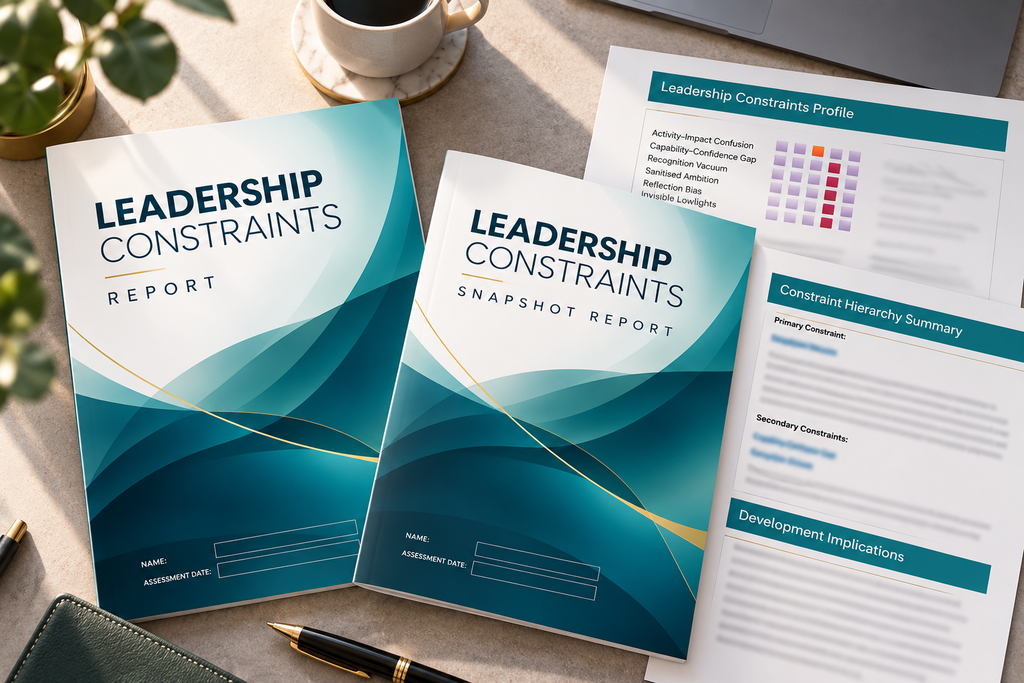
The diagnostic provides a starting point rather than a verdict.
Responses are interpreted alongside context, experience and other available evidence.
This matters because leadership behaviour is rarely adequately understood through a score alone.
The purpose is not to produce six numbers.
It is to generate better developmental insight.
Identifying the primary Constraint
Several Constraints may be relevant to the same leader.
That does not mean they are equally important.
The Leadership Constraints approach therefore seeks to understand where the strongest evidence of current developmental impact lies.
This may indicate a primary Constraint — the pattern that appears most significant in limiting fuller capability expression at that point in the leader’s development.
Other Constraints may reinforce it.
Others may be present but relatively unimportant.
And some may not be meaningfully present at all.
This prioritisation matters.
Without it, leadership development can easily become an expanding list of things to work on.
A more useful question is:
Where could focused attention create the greatest developmental movement?
From Constraint to capability expression
Identifying a Constraint is not the end point.
It is the beginning of a more focused conversation about capability expression.
Consider two leaders with similar capability.
One may translate that capability into wider organisational influence, strategic contribution and progression.
The other may remain heavily operational, insufficiently visible, hesitant about broader responsibility or constrained by assumptions formed through earlier experience.
Their underlying capability may be comparable.
Its expression is not.
This is why the framework focuses not only on what a leader possesses, but on what enables that capability to travel.
Capability Expression is the outcome we are trying to strengthen — not another Leadership Constraint.
The Manager Effect

Leadership development does not happen in isolation
A leader’s behaviour develops within an organisational environment.
Managers are an important part of that environment.
They can help reduce a Leadership Constraint.
They can also unintentionally reinforce one.
A highly dependable leader may continue to receive more operational work precisely because they are so good at delivering it.
A capable individual whose contribution is insufficiently visible may have a manager who values them greatly but does little to create wider exposure.
A leader with understated ambition may rarely be asked directly what they want next.
Someone whose confidence lags behind capability may continue to receive reassurance without being given the stretch that would provide stronger evidence of readiness.
This is the Manager Effect.
It recognises that what appears to be an individual development issue may be partly maintained by the environment surrounding the individual.
That changes the question from:
“What does this leader need to change?”
to:
“What does the leader need to change — and what might the surrounding environment need to do differently?”
Why the Manager Effect matters
Managers often reinforce Constraints for entirely understandable reasons.
The operationally immersed leader gets more work because they are reliable.
The modest high performer is left alone because they appear content.
The person who lacks confidence is protected because the manager wants to be supportive.
The experienced expert receives little challenge because their judgement is trusted.
None of these actions necessarily reflects poor management.
But their cumulative effect can maintain a pattern that eventually restricts development.
The Manager Effect therefore introduces an important organisational dimension:
Sometimes releasing more leadership capability requires change around the leader as well as within the leader.
From insight to action
A useful diagnosis should change something.
Once a significant Constraint has been identified, development can become more focused.
The precise action depends upon the leader, the Constraint and the organisational context.
For one person, the priority may be deliberately stepping back from operational involvement.
For another, it may involve building relationships beyond the immediate circle of recognition.
Another may need to articulate a career aspiration more explicitly.
Someone else may need to test a familiar interpretation against genuinely different perspectives.
Or development may involve recognising that the evidence of readiness is already stronger than the individual’s confidence suggests.
The intervention therefore follows the evidence.
Not every leader needs the same development because not every leader is constrained in the same way.
Development without discarding strengths
Leadership Constraints does not assume that the behaviours associated with a Constraint should simply be eliminated.
Quite the opposite.
Many have considerable value.
Commitment to delivery remains important.
Modesty can remain a strength.
Experience should continue to inform judgement.
Resilience remains valuable.
Careful consideration before taking a risk can be entirely appropriate.
The objective is greater choice.
The leader becomes better able to recognise when an established pattern is useful and when it has begun to limit what the situation now requires.
Development then becomes less about replacing one behaviour with another and more about expanding the leader’s available range.
Applying the framework

Leadership Constraints can be used in several ways.
Individual Diagnostic & Debrief
A structured exploration of the six Constraints to identify significant patterns, examine their impact and establish focused development priorities.
Executive Coaching
The framework can provide a sharper developmental hypothesis for coaching, particularly where the leader already possesses substantial capability and conventional development objectives feel insufficient.
Leadership Development
Leadership programmes can use the Constraints to help participants examine not only what they are learning, but what may affect their ability to translate that learning into wider impact.
Assessment & Development
The framework can complement existing assessment evidence by exploring factors that may affect how fully demonstrated capability is subsequently expressed.
Talent & Succession
Leadership Constraints can add depth to discussions about people whose capability may be stronger than their organisational visibility, confidence or stated ambition suggests.
Organisational Application
Patterns across a leadership population can provide useful insight into the environment in which leaders are developing — including the possible influence of the Manager Effect.
The central question
Leadership development will always need to build capability.
But there comes a point when adding more may no longer be the most important intervention.
For some capable leaders, the greater opportunity is to understand what is preventing existing capability from having its fullest effect.
What is already there?
What is constraining its expression?
What might become possible if that constraint were reduced?
That is the Leadership Constraints approach.