Exploring the thinking behind Leadership Constraints
Leadership Constraints has developed through leadership assessment, executive coaching and development work with capable leaders whose performance remained strong, but whose wider organisational impact did not always continue to expand at the same rate.
The Six Leadership Constraints article series explores the recurring patterns behind that observation.
Each article examines one Constraint: what it looks like in practice, why it can develop, how it can remain hidden while performance continues, and why it matters for both leaders and organisations.

Introducing the Leadership Constraints
Why Capable Leaders Sometimes Stop Growing — When Performance Masks Stabilisation
This introductory article explores why otherwise capable leaders can reach a point where continued strong performance masks a gradual slowing of their professional growth. It introduces the six Leadership Constraints and provides the foundation for the series that follows.
The Six Leadership Constraints Series
1 — Activity–Impact Confusion

When Operational Excellence Limits Organisational Influence
Strong delivery builds credibility. But as leadership responsibility increases, continued immersion in operational activity can begin to limit the time and attention available for enterprise-level contribution.
The first article explores why highly dependable leaders can remain closely involved in execution even when their role increasingly requires them to extend influence, shape direction and build organisational capability.
The risk is not underperformance. It is that leadership capability fails to scale with organisational need.
2 — Capability–Confidence Gap
When Readiness Exists but Forward Movement Stalls
Some capable leaders delay progression not because ability is absent, but because their threshold for feeling ready remains unusually high.
This article explores how strong performers can continue accumulating experience while hesitating to enter broader organisational territory until they feel almost completely prepared.
The developmental shift is not about lowering standards. It is about recognising that readiness for more senior leadership is partly built through movement and stretch rather than complete preparation beforehand.

3 — Recognition Vacuum

When Strong Contribution Remains Organisationally Invisible
Performance does not automatically create visibility.
A leader can be highly regarded within an immediate environment while the wider organisation sees only part of the contribution and capability that colleagues close to the work experience directly.
Recognition Vacuum examines the gap between contribution and organisational awareness — and why addressing it does not require leaders to become self-promotional.
The shift is from assuming visibility will follow performance to taking deliberate ownership of how contribution and organisational impact are understood.
4 — Sanitised Ambition
When Capable Leaders Understate Their Future Potential
Ambition is not always absent when it is difficult to see.
Capable leaders may deliberately moderate the way they discuss future aspirations because they do not want to appear political, self-interested or overly concerned with personal progression.
The result can be an unintended ambiguity: the organisation sees strong performance but receives little indication of the scale of contribution the leader wants to make next.
The article explores the difference between personal self-promotion and articulating ambition in terms of future organisational contribution.

5 — Reflection Bias

When Experience Reinforces the Familiar Rather Than Challenging Assumptions
Experience is one of leadership’s greatest assets.
But accumulated experience can also make familiar explanations increasingly persuasive.
Reflection Bias explores what happens when thoughtful, experienced leaders continue to reflect but their reflection increasingly confirms established interpretations rather than genuinely expanding them.
The issue is not an absence of reflection.
What may be missing is reinterpretation.
Leaders who continue growing treat experience as evidence rather than conclusion.
6 — Invisible Lowlights
The Experiences That Redefine What Feels Possible
Some of the most influential experiences in a leadership career are not the achievements that appear on a CV.
They are the disappointments, periods of under-recognition, missed opportunities and difficult relationships that apparently pass — while the adaptations they created continue.
Invisible Lowlights examines how leaders can remain successful and resilient while earlier experiences quietly reshape expectations, aspiration, trust and willingness to pursue future opportunities.
The distinction is important:
Resilience and developmental integration are not necessarily the same thing.

One series. A common pattern.
Although the six Constraints appear differently, the completed series identifies something they share.
They rarely represent an absence of capability.
More often, they are patterns of assumptions, habits and adaptations that can stabilise leadership behaviour even while performance remains strong.
The organisational challenge is therefore not simply to continue developing capability, but to recognise what may gradually limit how existing capability is applied, expanded and translated into broader organisational contribution.
That is the proposition at the heart of Leadership Constraints.
Conversations
Leadership Constraints in conversation
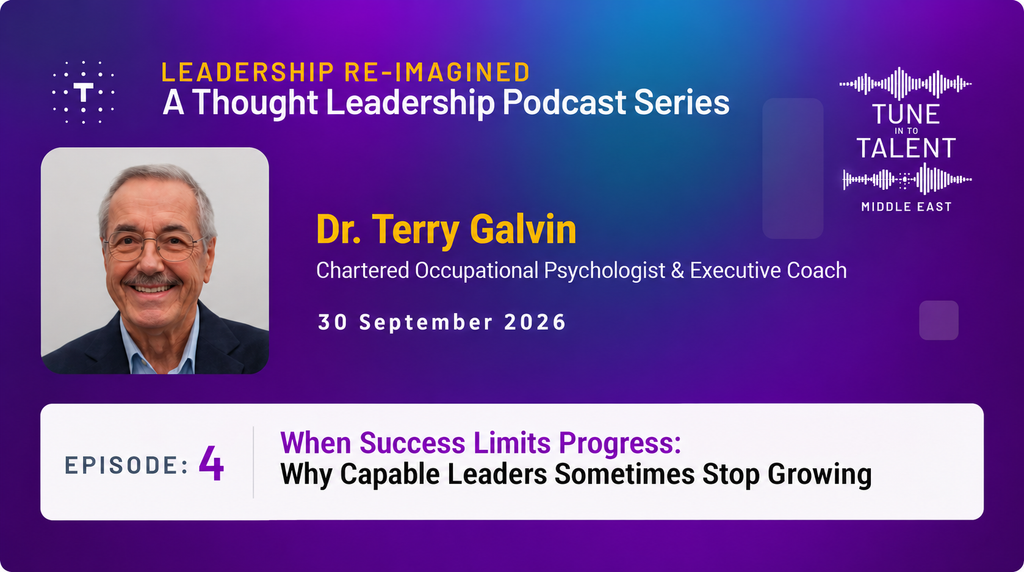
When Success Limits Progress: Breaking Through Leadership Constraints
My recent conversation with Munir Burhan provided an opportunity to step back from the individual Constraints and explore the broader question behind the framework:
What if the capability is already there?
The discussion considers why adding knowledge, skills and experience may sometimes address only part of the developmental challenge — and why capable leaders and their organisations may benefit from examining what is constraining the fuller expression of capability already present.
Continuing the thinking
The six articles establish the foundations of Leadership Constraints.
The work does not end there.
Further writing and conversations will explore the wider implications of the framework, including:
Capability Expression — the translation of existing capability into wider leadership and organisational impact.
The Manager Effect — how the environment surrounding a leader can reinforce or reduce a Constraint.
Interactions between Constraints — how apparently separate patterns can influence and sustain one another.
Organisational implications — what recurring Constraints across a leadership population may reveal about the environment in which leadership capability is expected to develop.
New articles, conversations and research will be added here as the thinking develops.